
Views: 0 Author: Site Editor Publish Time: 2026-06-29 Origin: Site


A ghillie suit designed for a damp pine forest will easily compromise your position in an arid scrubland. Worse still, wearing heavy camouflage in high-heat zones severely risks heat exhaustion and degrades physical performance. Off-the-shelf camouflage rarely aligns completely with specific local terrains out of the box. Buyers often focus intensely on aesthetic thread density rather than practical mobility, thermal load, and the ability to attach native vegetation. We provide a strict, environment-first evaluation framework below. You will learn how to shortlist the right base material, weight class, and pattern for your specific operational or hunting environment. Selecting proper camouflage requires evaluating terrain demands, weather conditions, and your expected movement levels. This guide ensures you match your gear directly to the real-world tactical demands you face.
Environment dictates base material: High-heat, low-cover environments require macromesh bases, while dense, abrasive environments demand ripstop foundations.
Out-of-the-box is a myth: The most effective camouflage relies on built-in tie-points (paracord grids/elastic bands) for integrating local, natural vegetation.
Synthetic vs. Jute: Synthetic threads offer lighter weight and water resistance; natural jute provides superior depth and texture but absorbs water and increases weight.
System integration matters: A ghillie top must integrate seamlessly with your load-bearing equipment and underlying combat uniforms for field use.
Mismatching a suit to the terrain leads directly to silhouette exposure. It also causes immense physical fatigue. Proper evaluation must start by analyzing your local climate and your expected movement requirements. We see many buyers fail because they purchase gear based on visual appeal rather than environmental reality.
Your role in the field dictates the weight and coverage of your camouflage. You must balance maximum concealment against your ability to move freely.
Static positions (Snipers/Ambush Hunters): Operators holding fixed positions can utilize heavier, full-coverage suits. You might wear a jacket, pants, boonie hat, and a rifle wrap to achieve maximum depth. Thermal buildup is less critical when you remain completely still.
Dynamic movement (Stalkers/Paintball/Airsoft): Fast-moving operators require half-suits, such as Vipers or Cobras, or lightweight capes. These minimalist garments prevent overheating. They also severely reduce brush snagging while crawling.
The foundation garment supports all camouflage elements. Your choice here determines airflow and durability.
Common Mistake: Choosing a heavy ripstop base for mid-summer stalking often leads to severe heat exhaustion.
Foundation Type | Best Environment | Primary Advantage | Notable Drawback |
|---|---|---|---|
Breathable Mesh | Summer / Desert Operations | Maximum ventilation and lightweight feel. | Lower snag resistance in thorny brush. |
BDU/Ripstop Base | Dense Forests / Brambles | Highly durable for aggressive crawling. | Heavier and retains significant body heat. |
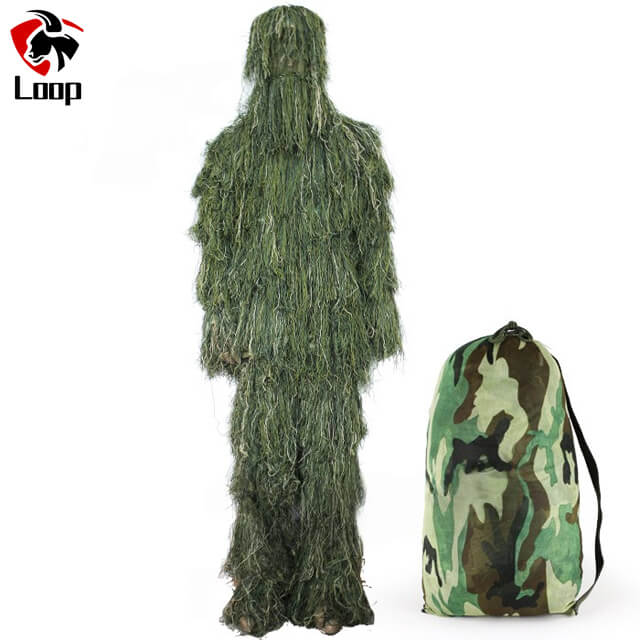
Evaluating standard color profiles helps you select a strong baseline. However, you must also know when to modify factory colors to match local foliage changes.
Tropical environments demand specific design choices to combat moisture and rot. A dedicated jungle camouflage ghillie suit relies heavily on a specialized color palette containing high-contrast dark greens, rich browns, and deep blacks.
Material needs strictly lean toward synthetic fibers. Natural jute acts like a sponge in humid jungles. It absorbs ambient humidity, doubling in weight, and rapidly develops toxic mold. Structure also plays a vital role here. The garment needs heavy-duty reinforcement across the chest and knees. You will spend hours crawling over wet, rotting logs and abrasive stones.
Arid landscapes require an entirely different approach to camouflage. A proper desert camouflage ghillie suit utilizes a palette of flat tans, light browns, and sparse sage greens.
Material needs prioritize an ultra-lightweight mesh base. This mitigates extreme heat retention under the blazing sun. Texture remains equally important. Desert suits require much shorter thread lengths to mimic sparse, low-lying brush. Long threads create a "shaggy dog" look. This bulky profile creates unnatural shadows and stands out horribly in flat, open terrain.
Off-the-shelf suits routinely fail in highly specific micro-climates. Unique shadows and distinctive foliage structures demand targeted solutions. For example, the sharp, blocky needle clusters of Juniper bushes do not look like standard trailing thread. These environments require targeted 3D leaf suits or heavily customized base mesh systems rather than standard commercial options.
Structuring the choice between traditional thread models and modern leaf cuts ensures better field performance. Both categories serve distinct tactical purposes.
Pros: Offers unmatched 3D depth. It disrupts the human silhouette completely by mimicking dense, chaotic undergrowth.
Cons: Generally heavy and highly prone to snagging on branches. It holds field debris endlessly and creates higher thermal retention.
Pros: Extremely lightweight and highly packable. These suits provide excellent airflow for high-mobility stalking operations.
Cons: Lacks true deep texture. The laser-cut leaves can appear completely flat in dense, deeply layered woodland underbrush.
Decision Logic: Choose traditional threads for deep, static woodland ambushes where silhouette disruption is paramount. Choose 3D leaf suits for active stalking, rapid movement, or high-temperature environments.
When reviewing a manufacturer's ghillie suit product range, you must map specific features directly to field outcomes. Ignore purely aesthetic choices and focus on functional survival traits.
A true trust indicator of a high-quality suit is its tie-in grid. Do not buy a suit lacking a paracord grid, heavy elastic loops, or robust netting. A baseline suit must accept local vegetation like native twigs, leaves, and tall grass. Factory threads only provide a base layer; adding native foliage achieves true invisibility.
Best Practice: Try weaving 70% natural local vegetation and 30% factory synthetic thread to fully break up solid geometric shapes.
Your camouflage top layer must accommodate your foundational gear. Evaluate exactly how the suit fits over standard combat uniforms for field use. Ensure the design allows quick access to uniform pockets, duty belts, or specialized chest rigs. You should never have to compromise your camouflage layer just to reach a spare magazine or a radio.
Implementation risks run high regarding safety treatments. Untreated synthetic fibers melt into the skin, while dry natural jute acts as highly flammable tinder. You must verify factory fire-retardant (FR) treatments, especially for professional tactical deployments where flash bangs or flares are present. Additionally, assess the material for hydrophobic coatings. These advanced coatings aggressively prevent water-logging during sudden downpours in wet environments.
Advanced buyers eventually outgrow standard catalogs. Navigating advanced procurement requires understanding when to scale up and when to order bespoke solutions.
Sometimes you must bypass standard commercial catalogs entirely. Opt for a dedicated custom camouflage suit service when operating in highly specific micro-climates. Transitional seasons and very specific regional hunting zones demand exact color matching.
Customization points usually include precise thread color ratios, specific base garment selection, and professional pre-weathering services. Pre-weathering ensures the suit arrives looking naturally faded rather than factory-glossy.
When outfitting entire units, standardization becomes critical. If you handle bulk tactical gear procurement for military, law enforcement, or large airsoft teams, opt for adjustable poncho or cape styles. These loose cuts easily fit varying body types over wildly diverse tactical loadouts.
Inventory management also plays a massive role here. Select modular systems rather than one-piece coveralls. Modular designs allow quartermasters to order hoods, capes, and leg wraps individually. This drastically reduces replacement bottlenecks when team members damage a single piece of their kit.
Your specific environment dictates your ideal base material, color palette, and weight class. Never prioritize aesthetic "bushiness" over critical mobility and thermal management. A heavy, beautiful suit serves no purpose if it causes heat stroke before you reach your objective. Audit your primary operating environment carefully today. Note the climate, dominant vegetation, and your required movement level. Then, decide firmly between a synthetic thread model or a 3D leaf base. Finally, ensure your shortlisted suit features an adequate paracord or elastic grid for local vegetation tie-ins.
A: It is difficult to change the factory base color permanently. However, you can alter the seasonal profile effectively by utilizing the suit's tie-in points. Simply attach dead brown grass for fall and winter operations, or weave in fresh green vegetation for spring and summer.
A: Yes. Ghillie suits act strictly as top camouflage layers. You should wear breathable, moisture-wicking combat uniforms for field use underneath. This base layer manages sweat buildup and protects your skin against severe environmental abrasions.
A: Never machine wash your camouflage. Hand wash it in a tub of cold water using scent-free detergent. Remove all field debris like twigs and burrs manually. Always air dry it completely to prevent mold, especially in suits containing natural jute.


