

Ballistic Helmet – Comprehensive Guide
Products Introduce
Armyloop (Loop Circle) focuses on the R&D and manufacturing of high quality ballistic helmets to ensure the safety and reliability of military personnel and law enforcement officers during missions.
Product Center
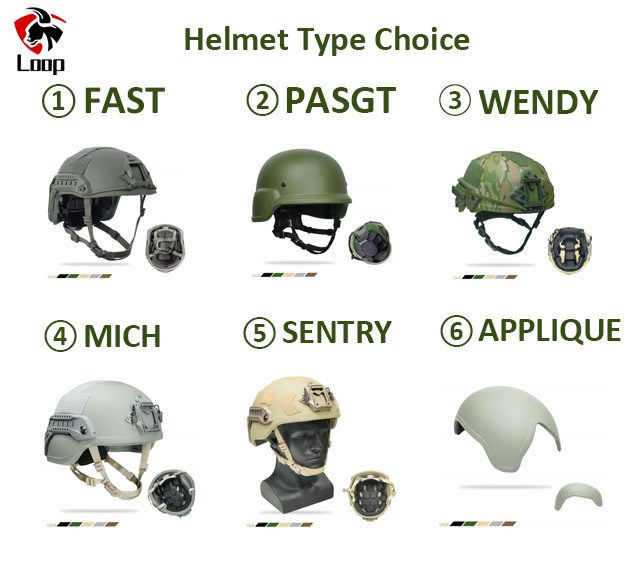
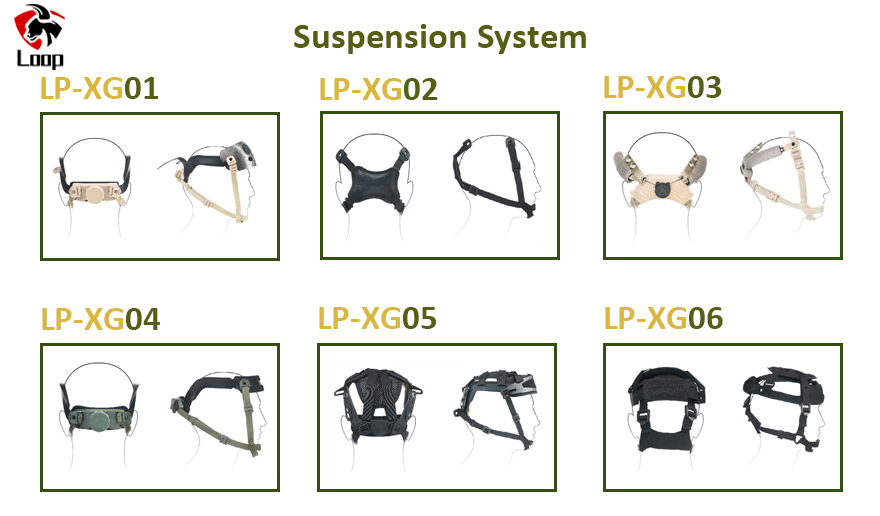
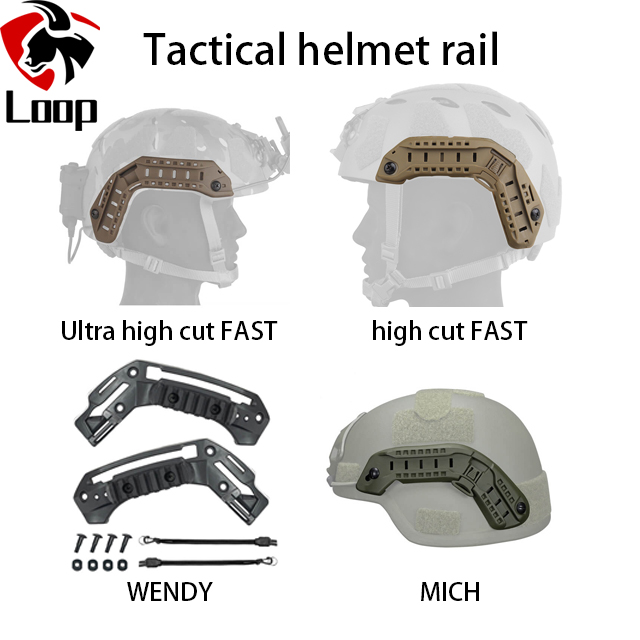
Armyloop offers a variety of military helmets, including lightweight, high-strength tactical helmets, as well as customized solutions suitable for different operational environments.We have FAST , PASGT TYPE, WENDY, MICH, SENTRY, APPLIQUE TYPE ballistic helmet for option. And we also provide 6 suspension system and 4 rails for customers as picture showing.


Product Showcase


Product Advantages
| Basic Information | ||
| Size | M/L/XL/XXL,Customization based on customer requirements. | |
| Color | Black, Green, Sandy, Coyote, Grey,cutomized color. | |
| Packaging | Professional protective carton to ensure safety during transportation | |
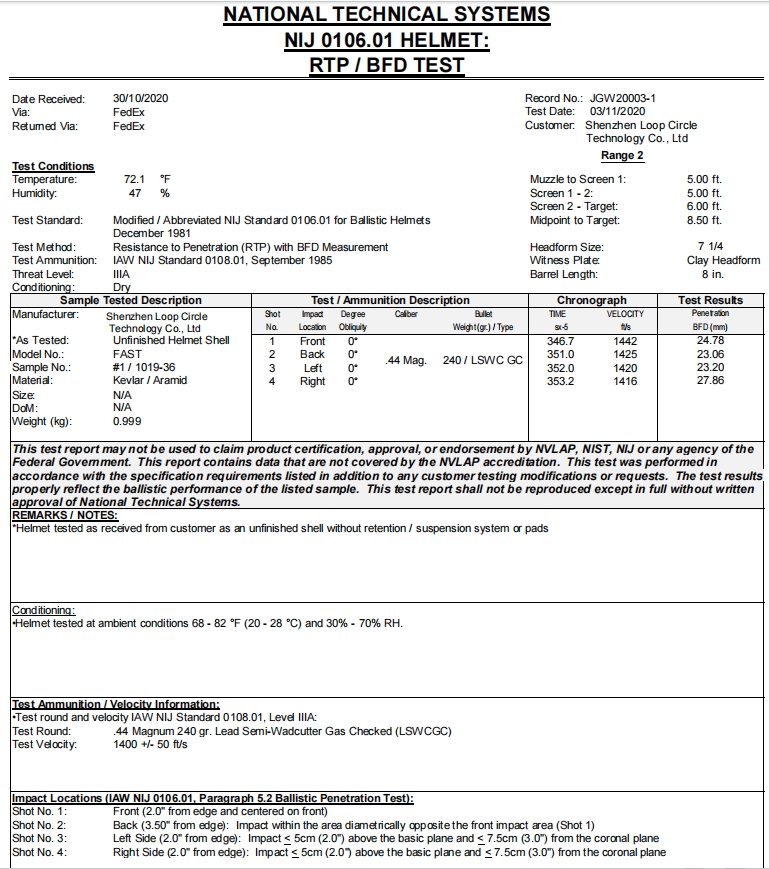
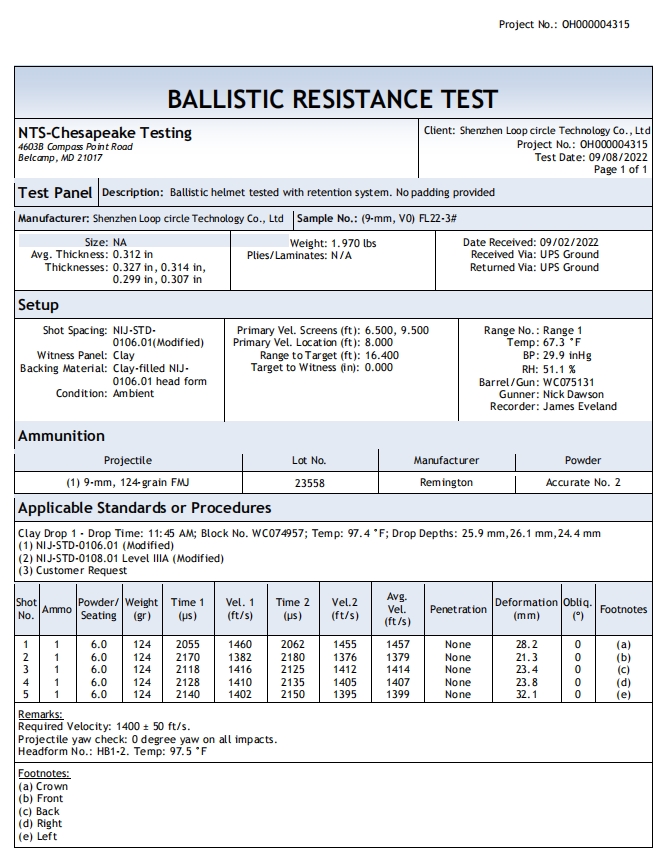
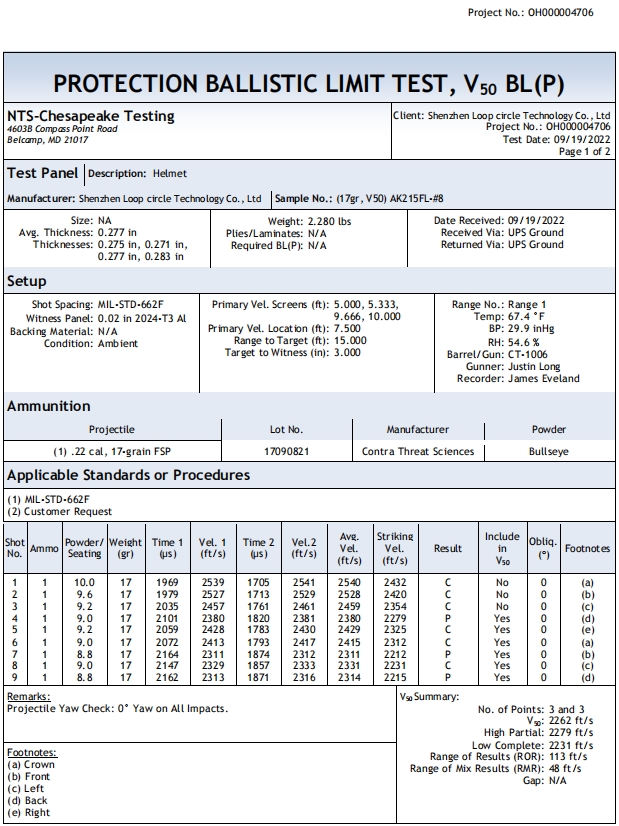
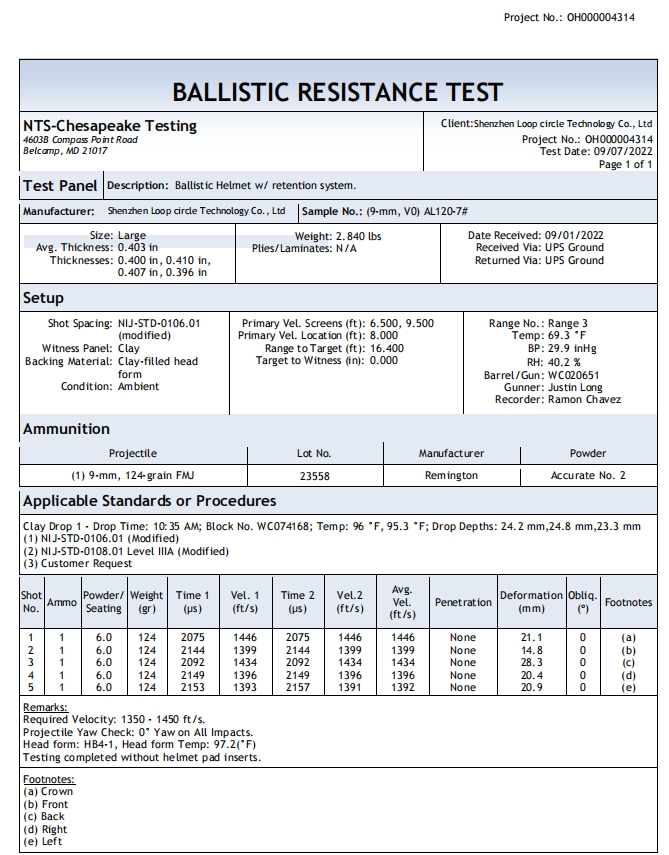
| Certificate | Our helmet passed NIJ IIIa, NIJ III testing. | |

Technical Specifications
| Ballistic Helmet | ||
| Size | Multiple sizes available | |
| Model | Customized based on specific needs | |
| Protection Level | Complies with international standards, such as NIJ, EN, etc.We listed the NIJ standards for reference as below. | |
| Material | UHMWPE, Kevlar( aramid), Advanced composite materials used to ensure lightweight and high strength | |
| NIJ armor standard | ||
| Ballistic resistance (before April 2024) | ||
| NIJ Standard-0101.06 had specific performance standards for bullet resistant vests used by law enforcement. This rated vests on the following scale against penetration and also blunt trauma protection (deformation): | ||
| Armor Level | Protection | |
| Level I .22 LR .380 ACP | This armor would protect against 2.6 g (40 gr) .22 Long Rifle Lead Round Nose (LR LRN) bullets at a velocity of 329 m/s (1080 ft/s ± 30 ft/s) 6.2 g (95 gr) .380 ACP Full Metal Jacketed Round Nose (FMJ RN) bullets at a velocity of 322 m/s (1055 ft/s ± 30 ft/s). It is no longer part of the standard. | |
| Level IIA 9×19mm .40 S&W .45 ACP | New armor protects against: 8 g (124 gr) 9×19mm Parabellum Full Metal Jacketed Round Nose (FMJ RN) bullets at a velocity of 373 m/s ± 9.1 m/s (1225 ft/s ± 30 ft/s) 11.7 g (180 gr) .40 S&W Full Metal Jacketed (FMJ) bullets at a velocity of 352 m/s ± 9.1 m/s (1155 ft/s ± 30 ft/s) 14.9 g (230 gr) .45 ACP Full Metal Jacketed (FMJ) bullets at a velocity of 275 m/s ± 9.1 m/s (900 ft/s ± 30 ft/s). Conditioned armor protects against 8 g (124 gr) 9 mm FMJ RN bullets at a velocity of 355 m/s ± 9.1 m/s (1165 ft/s ± 30 ft/s) 11.7 g (180 gr) .40 S&W FMJ bullets at a velocity of 325 m/s ± 9.1 m/s (1065 ft/s ± 30 ft/s) 14.9 g (230 gr) .45 ACP Full Metal Jacketed (FMJ) bullets at a velocity of 259 m/s ± 9.1 m/s (850 ft/s ± 30 ft/s). It also provides protection against the threats mentioned in [Type I]. | |
| Level II 9mm +P .357 Magnum | New armor protects against 8 g (124 gr) 9 mm FMJ RN bullets at a velocity of 398 m/s ± 9.1 m/s (1305 ft/s ± 30 ft/s) 10.2 g (158 gr) .357 Magnum Jacketed Soft Point bullets at a velocity of 436 m/s ± 9.1 m/s (1430 ft/s ± 30 ft/s). Conditioned armor protects against 8 g (124 gr) 9 mm FMJ RN bullets at a velocity of 379 m/s ±9.1 m/s (1245 ft/s ± 30 ft/s) 10.2 g (158 gr) .357 Magnum Jacketed Soft Point bullets at a velocity of 408 m/s ±9.1 m/s (1340 ft/s ± 30 ft/s). It also provides protection against the threats mentioned in [Types I and IIA]. | |
| Level IIIA .357 SIG .44 Magnum | New armor protects against 8.1 g (125 gr) .357 SIG FMJ Flat Nose (FN) bullets at a velocity of 448 m/s ± 9.1 m/s (1470 ft/s ± 30 ft/s) 15.6 g (240 gr) .44 Magnum Semi Jacketed Hollow Point (SJHP) bullets at a velocity of 436 m/s (1430 ft/s ± 30 ft/s). Conditioned armor protects against 8.1 g (125 gr) .357 SIG FMJ Flat Nose (FN) bullets at a velocity of 430 m/s ± 9.1 m/s (1410 ft/s ± 30 ft/s) 15.6 g (240 gr) .44 Magnum Semi Jacketed Hollow Point (SJHP) bullets at a velocity of 408 m/s ± 9.1 m/s (1340 ft/s ± 30 ft/s). It also provides protection against most handgun threats, as well as the threats mentioned in [Types I, IIA, and II]. | |
| Level III 7.62×51mm NATO M80 | Conditioned armor protects against 9.6 g (148 gr) 7.62×51mm NATO M80 ball bullets at a velocity of 847 m/s ± 9.1 m/s (2780 ft/s ± 30 ft/s). It also provides protection against the threats mentioned in [Types I, IIA, II, and IIIA]. | |
| Level IV .30-06 Springfield M2 | Conditioned armor protects against 10.8 g (166 gr) .30-06 Springfield M2 armor-piercing (AP) bullets at a velocity of 878 m/s ± 9.1 m/s (2880 ft/s ± 30 ft/s). It also provides at least single hit protection against the threats mentioned in [Types I, IIA, II, IIIA, and III]. | |
Application

Military Operations
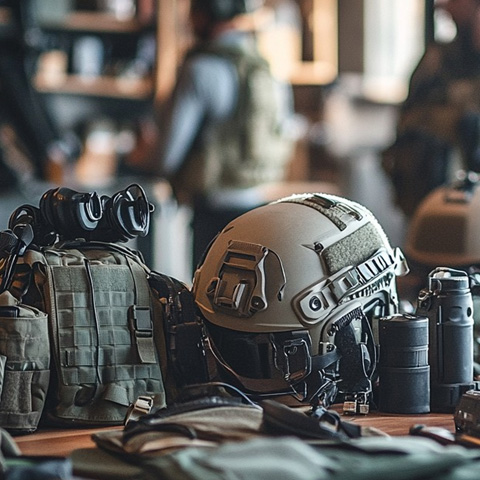
Providing reliable head protection for military personnel to ensure safety in complex and dangerous operational environments.
Law Enforcement Actions
Offering necessary protection for law enforcement officers to support their safety and efficiency during missions.
FAQs
Safe
Weight and Size
Protection Level Selection
Cleaning and Maintenance
Related Blogs
In today's complex and ever-changing environment, a ballistic helmet has become an indispensable piece of protective gear for military personnel, law enforcement, security specialists, and even civilians. An excellent ballistic helmet not only effectively withstands the threat of shrapnel and bullet
Read More
In today's complex and ever-changing environment, a ballistic helmet has become an indispensable piece of protective gear for military personnel, law enforcement, security specialists, and even civilians. An excellent ballistic helmet not only effectively withstands the threat of shrapnel and bullet
Read More This article introduces 10 representative ballistic vest manufacturers in the U.S. market in 2026 from the perspectives of company background, product direction, market positioning, and procurement characteristics, providing an industry reference for ballistic equipment buyers, tactical equipment distributors, wholesalers, and international buyers.
Read More
In the global defence and security industry, the Egypt Defence Expo (EDEX) is one of the representative international defence exhibitions in North Africa.
Read More
Defeat armor-piercing threats without the heavy physical toll. Discover how lightweight Level 4 plates maximize mobility and reduce fatigue.
Read More
Upgrade to lightweight UHMWPE ballistic helmets. Cut headborne weight by 20%, eliminate neck strain, and ensure verified NIJ IIIA protection.
Read More
Heavy armor causes fatigue. Discover the lightest Level 4 plates offering armor-piercing protection without sacrificing tactical mobility.
Read More
Discover how MICH tactical helmets balance NIJ IIIA ballistic protection with seamless headset integration for maximum operator safety and mobility.
Read More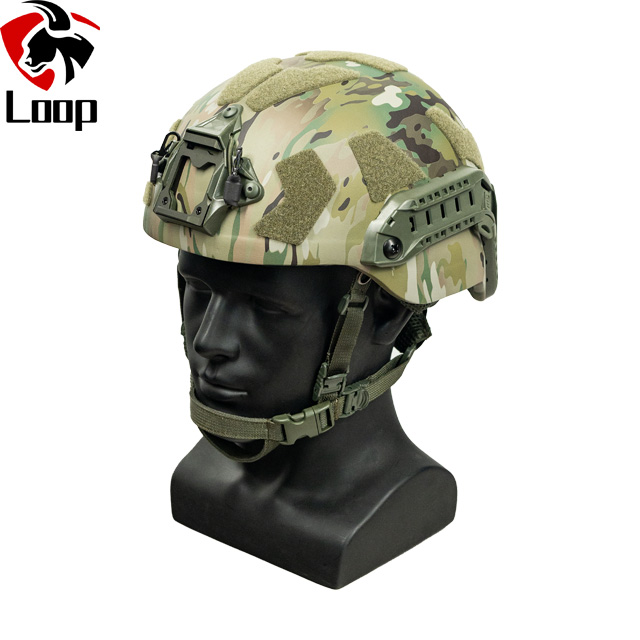
The design of a tactical vest needs to balance protective coverage, weight, mobility, ventilation, and equipment-carrying capability. Excessive coverage may provide a larger protection area, but it can also result in higher weight, reduced ventilation, and restricted movement.
Read More
As one of the most influential international defence and security exhibitions in the Middle East, the International Defence Exhibition & Conference (IDEX) has become an important platform for global defence companies, military organizations, government agencies, security institutions, and professional buyers to communicate and cooperate.
Read More
Stop neck strain with a UHMWPE tactical helmet. Discover how lightweight PE ballistic armor delivers NIJ IIIA protection at 30% less weight.
Read More
Related Videos
In complex military operational environments, reliable head protection is key to ensuring the safety of military personnel. Armyloop's ballistic helmets offer superior protection performance, supporting military personnel in maintaining safety and efficiency during various missions.
Contact Us –
Get a Free Quote Today!
For more information, contact us today for expert advice and an accurate quote.
Tel: +86-13929428415
Email: tracy@glz.sinanet.com
Add: 315 Tianhui Building, Youasong Road, Longhua District, Shenzhen, Guangdong, China
