
Views: 0 Author: Site Editor Publish Time: 2026-06-22 Origin: Site


Choosing the wrong camouflage carries severe consequences in the field. Mismatched gear compromises your visual concealment immediately. Worse, it introduces dangerous physical risks to the wearer. You face acute heat exhaustion in scorching, arid environments. You risk severe water-logging, fatigue, and mobility loss in wet, humid regions.
Many online searches surface gaming statistics from titles like ARK or PUBG. We must clarify the scope here. This guide explicitly evaluates real-world, commercial-grade tactical and hunting gear. Digital armor stats simply do not translate to physical survival.
Our primary goal is providing a hard-nosed, objective framework. You will learn how to evaluate and select an environment-matched ghillie suit based on thermal dynamics, material science, and terrain specifics. This disciplined approach ensures you remain undetected and fully operational during extended deployments.
Visual Disruption: Desert suits rely on sparse, lighter palettes (tans, dry browns) to mimic dead vegetation; jungle suits use dense, high-contrast greens and dark earth tones to blend into deep canopy shadows.
Thermal & Moisture Management: A desert ghillie suit prioritizes maximum airflow and heat dissipation, while a jungle suit focuses on water-shedding capabilities and rot resistance.
Thread Density & Snag Risks: Jungle suits require tighter, snag-resistant construction to navigate dense brush; desert suits utilize sparser thread distribution to match open, arid landscapes.
Material Realities: Synthetic fibers have largely replaced traditional jute in both environments to reduce weight and prevent dangerous water retention.
Camouflage works by tricking the human eye. It disrupts the recognizable human silhouette. Different terrains require entirely different visual strategies to achieve this disruption.
Arid landscapes lack dense vegetation. Sunlight bleaches the environment. A well-designed desert camouflage hunting suit reflects these harsh realities. It relies heavily on negative space. Manufacturers use specific color ratios to mimic dead brush and cracked earth. You will typically see dominance in sand, coyote tan, and pale olive tones. These lighter hues blend seamlessly into sparse, sun-baked terrain. Dark colors in a desert setting create a sharp contrast. This contrast immediately draws the human eye.
Tropical and woodland environments present the opposite challenge. You must navigate layered vegetation and shifting shadows. A modern jungle camouflage field suit requires complex patterns. It utilizes both "macro" and "micro" visual elements. Macro patterns break up the large outlines of your body. Micro patterns hide small movements from nearby observers. These suits feature deep greens, muddy browns, and stark blacks. These darker shades replicate the dense, layered shadows found under thick canopy cover.
Visual color represents only one part of concealment. You must also evaluate the invisible spectrum. Sunlight contains ultraviolet (UV) rays. Cheap fabrics often contain optical brighteners. These brighteners absorb UV light and reflect it. Animals like deer easily spot this unnatural glow. Furthermore, tactical operators face adversaries using Night Vision Goggles (NVGs). Your gear must be Near-Infrared (NIR) compliant. Incorrect dyes will "glow" brightly under night vision. This happens regardless of how perfectly the visible colors match the surrounding dirt. Always verify NIR compliance before deploying.
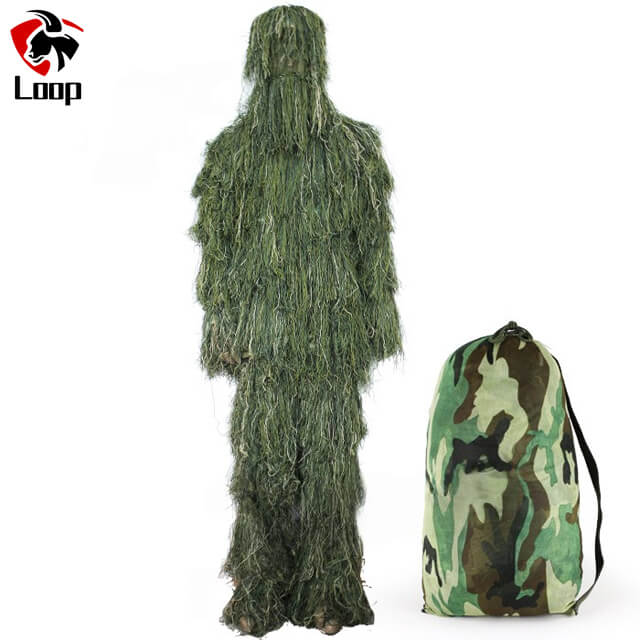
The physical environment dictates your material choices. A suit must protect you from detection while keeping your core body temperature stable.
Arid climates present a severe thermal threat. Direct sunlight and high ambient temperatures quickly overheat operators. You must wear breathable camouflage clothing. Heat retention causes rapid dehydration and cognitive decline. A true desert ghillie suit utilizes advanced mesh-base layers. These layers promote maximum airflow. Manufacturers use lightweight synthetic threads instead of heavy burlap. The design actively vents trapped body heat away from your skin.
Jungle environments attack your gear differently. You face extreme humidity, frequent downpours, and standing water. Traditional jute thread fails miserably here. Jute absorbs water rapidly. It quickly doubles in weight. It traps moisture against your skin. Worse, natural jute develops mildew and rots in humid conditions. This rot creates a distinct odor. Animals and adversaries can smell this decay. Therefore, modern jungle suits rely entirely on hydrophobic synthetic materials. These synthetics repel water, dry quickly, and resist fungal growth.
We must acknowledge a hard truth. No ghillie suit feels "cool" to wear. Adding 3D material over your base uniform inherently traps some heat. The primary goal is mitigating this thermal burden. You cannot eliminate it entirely. Proper hydration and intelligent pacing remain critical for survival.
Property Feature | Desert Optimization | Jungle Optimization |
|---|---|---|
Primary Threat | Heat exhaustion and UV exposure | Water retention and fabric rot |
Base Material | Open-weave synthetic mesh | Tightly woven, hydrophobic nylon |
Thread Type | Ultra-lightweight synthetic yarn | Water-repellent laser-cut leaves |
Airflow Capacity | Maximum ventilation | Moderate ventilation |
Your ability to move silently dictates your success. The density of your suit directly impacts your agility across different terrains.
Tropical forests contain thorns, vines, and thick undergrowth. A premium jungle tactical ghillie suit anticipates these hazards. It must feature snag-resistant netting. Loose threads easily catch on branches. This creates unnatural movement and loud noises. Furthermore, operators spend hours crawling through mud. Jungle suits require heavily reinforced high-wear areas. Manufacturers typically add rugged Cordura panels to the knees, elbows, and chest. These reinforcements prevent the suit from tearing during low crawls.
Desert environments offer open sightlines and sparse cover. Operators often crawl over sharp rocks and loose sand. Desert suits utilize a noticeably sparser thread count. Open plains require less 3D bulk to break up the human silhouette. This reduced density lowers the overall garment weight. It improves your agility and speed. You can maneuver quietly without dragging excessive material across the hard ground.
Your underlying uniform plays a crucial role. It interacts directly with the ghillie top. In hot climates, operators often wear lightweight combat shirts beneath their suits. This maximizes core ventilation. In dense, wet woods, you might wear a full softshell jacket underneath. You must ensure the ghillie base mesh accommodates your chosen layers without restricting your arm movement.
Selecting the correct gear requires a structured approach. You must analyze your specific mission parameters before making a purchase.
Hunters in open plains face long stalks in direct sunlight. Your priorities remain clear. Focus entirely on weight reduction, UV treatment, and breathability. Every extra ounce drains your energy. Ensure the material lacks optical brighteners. Prioritize suits featuring a wide-open mesh backing. This allows ambient breezes to cool your core during extended stationary periods.
Woodland missions demand durability. You will push through wet brush and lie in damp soil. Prioritize rot-resistance above all else. Seek high-density 3D coverage to defeat close-range visual detection. Ensure the suit offers high abrasion resistance. You need tough materials protecting your joints during aggressive tactical movements.
Many beginners seek a perfect "all-terrain" ghillie suit. This concept represents a dangerous myth. A dense woodland suit will overheat you in the desert. A sparse arid suit leaves you exposed against lush green foliage. The only viable crossover solution is a modular suit system. These setups provide a neutral-colored base mesh.
Follow these steps to utilize a modular crossover suit:
Deploy to your specific operational area.
Harvest local, native vegetation from the immediate surroundings.
Tie the harvested grass, leaves, and twigs directly into the suit's paracord grid.
Blend the edges of the suit into the natural ground cover.
Refresh the vegetation periodically as it wilts and changes color.
Buying professional-grade gear requires careful vendor scrutiny. You must verify claims and demand hard data.
Always review the detailed spec sheet. High-end gear provides transparent technical data. Look for flame retardant (FR) coatings. Synthetic threads melt under high heat. FR treatments prevent catastrophic burns if exposed to flash fires. Verify the NIR compliance testing standards. Check the tear-strength ratings for the base mesh. A cheap mesh rips instantly when caught on a sturdy branch.
Proper sizing prevents operational failures. Ghillie suits function as over-garments. You rarely wear them directly against your skin. Consider your seasonal layers. Will you wear heavy winter jackets underneath? Tactical operators must account for bulky plate carriers and chest rigs. Always size up accordingly. A suit fitting too tightly restricts your breathing and limits your weapon manipulation.
Evaluate your custom combat uniform supplier carefully. Avoid companies making impossible marketing claims. No suit makes you "100% invisible." No fabric provides a "completely cooling" effect in the desert. Look for clear, transparent data regarding material composition. Trust suppliers detailing their use of 100% polyester laser-cut leaves over dyed natural burlap. Reliable vendors understand the harsh realities of field use and market their products honestly.
The decision logic remains straightforward. Choosing between a desert and jungle ghillie suit comes down to matching the primary environmental threat. You must balance the danger of extreme heat against severe moisture. You must weigh sparse cover against dense, snag-prone brush. Selecting the correct material prevents mission compromise and physical injury.
Take immediate action before your next deployment. Audit your primary operational environment carefully. Verify the base material of your shortlisted options. Insist on hydrophobic synthetic fibers. Finally, consult directly with a reputable supplier to guarantee your gear meets strict NIR-compliant standards. Proper preparation ensures you remain invisible and effective.
A: We strongly discourage this. The dark greens and muddy browns create a high-contrast silhouette against light terrain, making you highly visible. Furthermore, the heavier, denser build of jungle suits drastically reduces airflow. This significantly increases your risk of suffering severe heat exhaustion in arid climates.
A: Laser-cut synthetic mesh or lightweight hydrophobic threads provide the best performance. They offer maximum breathability and minimal weight. You should avoid natural jute or burlap entirely. Natural fibers retain excessive heat, absorb sweat, and add unnecessary bulk during desert operations.
A: No. While games assign fixed "heat resistance" or "stealth" stats to different armors, real-world performance is not static. Real effectiveness relies entirely on ambient temperature, proper user hydration, specific material properties, and integrating site-specific vegetation into the suit.
A: Off-the-shelf options usually suffice for casual hunting or airsoft. However, military operators, law enforcement, and serious big-game hunters need more. They should look for custom or highly modular base suits. These premium options allow precise sizing over tactical gear and the integration of local flora.


