
Views: 0 Author: Site Editor Publish Time: 2026-06-08 Origin: Site


Tactical professionals, hunters, and serious mil-sim players constantly face a difficult choice. They must balance absolute visual concealment against physical mobility and operational endurance. Choosing the wrong gear often leads to compromised positions. Worse, poor choices cause dangerous heat exhaustion. This dilemma boils down to comparing purpose-built 3D concealment systems against standard-issue 2D tactical apparel. Do you need to completely vanish in a static position? Or do you need to move quickly across dynamic terrain? Paintball enthusiasts and airsoft competitors also struggle to find the perfect balance. Buying the wrong apparel ruins weekend events. We aim to provide an evidence-based framework for this critical decision. You will learn exactly how to evaluate your operational needs. We will help you match the right system to specific environmental demands. We will also analyze your movement profiles. You will understand the science of silhouette disruption and thermal load. By the end, you will know exactly what to wear for your next deployment or hunt.
Core function differs: Ghillie suits defeat detection by physically breaking the human silhouette using 3D depth; camouflage uniforms rely on 2D color and pattern blending to trick the eye at a distance.
Mobility vs. Stealth tradeoff: Ghillie suits significantly increase thermal load, weight, and snag risks, making them poor choices for highly mobile operations.
Maintenance disparities: Tactical uniforms offer low-maintenance durability, whereas ghillies require meticulous base selection, environmental prepping, and specialized care to prevent rot or degradation.
Use-case alignment: Stationary ambush or observation mandates a ghillie; dynamic movement, patrol, and rapid engagement require standard tactical uniforms.
The human eye functions as an incredible motion detector. It naturally scans environments for recognizable shapes. Our brains easily detect contrast, symmetry, and unusual outlines. The infamous head-and-shoulders outline quickly gives away a hidden person. Predators and human adversaries alike lock onto this specific shape instantly. True invisibility requires breaking these ingrained mental shortcuts. You must defeat both foveal focus and peripheral detection. Your foveal vision focuses on sharp details directly in front of you. Your peripheral vision detects sudden motion and contrasting shadows on the edges. Camouflage must defeat both visual systems simultaneously.
A well-constructed camouflage concealment suit attacks visual perception physically. It utilizes physical depth rather than flat color. The suit uses jute, synthetic threads, and native vegetation. These materials create physical shadows. They provide organic textures. They completely destroy the human silhouette. You no longer look like a person hiding in a bush. Instead, you become the bush. The 3D elements flutter naturally in the breeze. This motion mimics surrounding leaves. It tricks the brain perfectly at close range.
Standard uniforms take an entirely different approach. A modern military camouflage BDU relies on printed macro and micro patterns. Think of digital pixels, fractal geometries, or broad woodland strokes. These flat patterns create false edges. They trick the eye into blending the wearer into background colors. They work exceptionally well at medium-to-long ranges. However, they fail to hide the human shape if you are silhouetted against a skyline. They also fail if you position yourself poorly in an open field. Flat fabric cannot cast natural micro-shadows. The smooth surface reflects light differently than rough bark or jagged leaves.
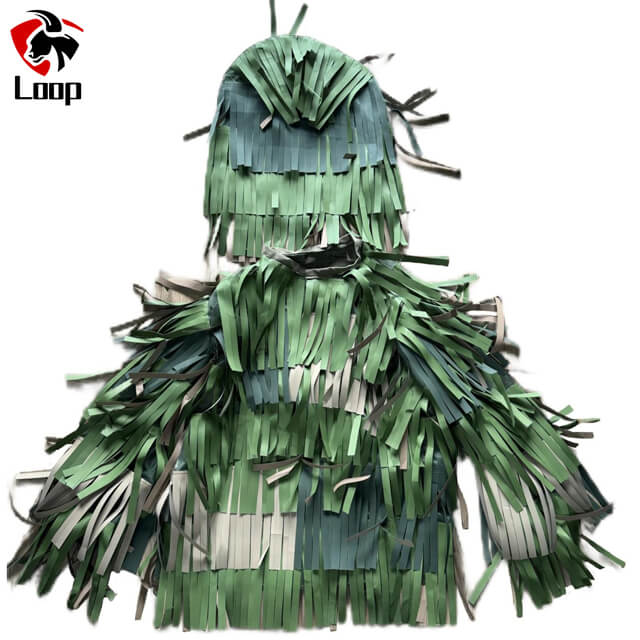
Wearing heavy 3D layers comes at a severe physical cost. Traditional suits trap an immense amount of body heat. This heat retention risk poses serious dangers. Field experts call this the thermal burden. It severely limits sustained cardiovascular output. You cannot run long distances wearing a thick jute layer. Core temperatures can spike dangerously high during strenuous activity. Heat stroke remains a real threat during summer operations. Safe use requires slow, deliberate movement. You must prioritize hydration constantly. A fully prepped sniper suit can weigh over ten pounds when dry. If it rains, the weight easily doubles. Your leg muscles burn rapidly during a low crawl under this heavy stress.
Netting and string interact poorly in dense environments. Thick brush, briars, and urban debris love hanging threads. Maneuverability drops significantly in tight spaces. Barbed wire fences become absolute nightmares. Drawing sidearms becomes a massive challenge. Accessing load-bearing equipment requires fighting through layers of material. Magazines and radios get lost under the vegetation. You trade operational agility for total invisibility. Snipers accept this trade-off. Assault teams cannot afford it.
Conversely, tactical combat uniforms prioritize athletic movement above all else. High-quality standard BDUs offer distinct ergonomic benefits. They feature articulated joints for bending and climbing. They utilize moisture-wicking properties to manage sweat effectively. Unrestricted weapon manipulation remains a top design priority. Operators can draw secondary weapons instantly. You can transition from a prone crawl to a full sprint effortlessly. You never have to fight your own clothes during a firefight. The streamlined profile prevents dangerous snags on doorways and vehicle hatches.
Jungles and swamps demand highly specialized gear. You must carefully evaluate a jungle camouflage ghillie suit before deployment. Synthetic fibers are absolutely mandatory here. Natural jute absorbs water like a sponge. Water-logged suits become unbearably heavy. They quickly develop rot and foul odors. Synthetic materials shed water easily. They also resist mildew and fungal growth. Meanwhile, standard uniforms excel in these wet zones. Quick-drying ripstop fabrics keep operators relatively comfortable. They prevent severe chafing during long patrols through humid riverbeds.
Deserts require a completely different approach. A desert camouflage ghillie suit must utilize lighter materials. Highly breathable mesh bases save lives in extreme heat. Heavy vegetation loops are counterproductive in barren sand dunes. Instead, you rely on sand and tan tonal blending. Less is always more in arid biomes. You want minimal bulk to catch the slight desert breeze. Excessive material just collects fine dust and irritating sand.
Standard uniforms remain completely static in their pattern. You cannot change a woodland pattern into a desert pattern on the fly. However, a well-built 3D suit requires constant adaptability. Field operators call this crucial process "veg-ing up." You must add local foliage to match the immediate micro-environment. If you move from a green valley to a brown hillside, you must swap your vegetation. You tie in local grasses, twigs, and leaves. It requires constant maintenance and keen situational awareness. You must replace dead, brown leaves if you are hiding in lush, green ferns.
Standard military apparel adheres to strict manufacturing guidelines. Excellent combat uniform quality control ensures long-term survival in harsh conditions. High-end tactical wear utilizes ripstop fabrics. These fabrics prevent tear propagation across the garment. They often feature Teflon coatings to repel water and oil. Manufacturers reinforce critical stress points. Operators spend countless hours on their knees and elbows. Standard apparel uses double-layered fabric inserts in these critical zones. You can even insert foam pads directly into modern uniform sleeves. Quality control also ensures NIR (Near Infrared) compliance. This treatment defeats enemy night vision threats. It keeps you from glowing brightly under infrared illuminators.
A 3D concealment system is only as strong as its foundation. Durability depends entirely on the base garment. A cheap, weak mesh base will rip open under crawling pressure. Snipers spend hours dragging themselves across abrasive terrain. Rocks and thorns tear at the fabric constantly. The stitching must withstand intense friction. High-quality bases use reinforced canvas or heavy-duty nylon mesh. If the base rips, the entire camouflage network unravels.
You can easily throw a dirty BDU into a standard washing machine. They clean up fast and air dry quickly. 3D suits demand careful, specialized care. You must hand-wash them in cold water. You must air-dry them away from direct sunlight. This maintains structural integrity and prevents rapid shrinkage. Furthermore, you can never use standard laundry detergents. Commercial soaps contain UV brighteners. These chemicals make fabrics glow intensely under night vision devices. A poorly washed suit becomes a glowing beacon to the enemy. Hunters also avoid scented detergents to bypass animal olfactory detection.
When weighing a ghillie suit vs camouflage uniform, your primary role dictates the choice. Use the following framework to align your gear. You must understand your movement speed and engagement ranges.
Choose the Ghillie Suit if:
Your primary role is stationary observation, sniping, or blind-free hunting.
You operate at close-to-medium ranges where breaking your physical outline is critical.
You have the time to prep the suit with local vegetation prior to deployment.
Your mission duration allows for slow, deliberate infiltration speeds.
Choose the Camouflage Uniform if:
Your role requires constant movement, squad-based tactics, or rapid repositioning.
You operate in extreme heat where thermal regulation is a strict safety requirement.
You need immediate, unhindered access to plate carriers, chest rigs, and duty belts.
You expect to engage in dynamic, fast-paced vehicle operations.
Sometimes you need a practical middle ground. The 3D Leaf Suit serves as a popular hybrid compromise. It is much lighter than traditional jute designs. It offers more physical texture than a flat BDU. Paintball players and active hunters often choose leaf suits. They provide a great balance of weight and stealth. Imagine a bow hunter tracking deer in late autumn. A leaf suit provides enough 3D texture to confuse an animal's vision. It remains light enough to allow a smooth, silent bow draw. They lack absolute outline-destroying depth, but they allow much better mobility.
Feature Category | 3D Concealment System | Standard Tactical Uniform |
|---|---|---|
Silhouette Disruption | Exceptional (Total outline destruction) | Moderate (Relies on distance and background) |
Mobility & Agility | Poor (High snag risk, bulky) | Excellent (Ergonomic, unrestricted movement) |
Thermal Load | High (Traps body heat easily) | Low (Moisture-wicking, breathable options) |
Maintenance Needs | High (Hand-wash, constant re-vegging) | Low (Machine washable, static pattern) |
Ideal Engagement Range | Close to Medium (Static positions) | Medium to Long (Dynamic movement) |
Neither option is universally superior. They are simply distinct tools. Engineers designed them for entirely different phases of an operation. We strongly recommend auditing your primary environment before buying gear. Check your typical movement speed. Measure your average engagement distances. Do not invest in a high-end concealment system blindly. A bulky suit ruins a dynamic patrol. A flat uniform fails a close-range sniper.
Take these immediate action steps before making a final decision:
Evaluate your physical fitness and heat tolerance before purchasing heavy 3D gear.
Analyze your local terrain colors to match your base patterns correctly.
Practice weapon manipulation in your chosen gear. You must identify snag points early.
Prioritize mission requirements over visual aesthetics every single time.
A: Yes, most professional ghillies are designed as over-garments, but doing so drastically increases heat retention. Breathable base layers are often preferred underneath.
A: High-quality tactical uniforms are treated to be NIR-compliant, meaning they absorb and reflect infrared light similarly to natural environments, preventing the wearer from "glowing" under night vision.
A: Leaf suits offer a better balance of weight and mobility with moderate 3D disruption, making them popular for paintball/airsoft and active hunting, though they lack the absolute outline-destroying depth of a traditional jute/synthetic ghillie.


