
Views: 0 Author: Site Editor Publish Time: 2026-08-24 Origin: Site


Tactical operators face a persistent physical challenge during extended deployments. Neck strain, chronic fatigue, and decreased situational awareness frequently plague teams wearing legacy headgear. These issues stem directly from excessive headborne weight. Modern operations demand multiple accessories. Night vision goggles, communication headsets, and strobe lights add significant mass. This combined load makes the base weight of traditional aramid shells a limiting factor. Operator endurance drops as cervical spine strain increases.
Materials science provides a practical leap forward. Ultra-High Molecular Weight Polyethylene (UHMWPE) represents a shift in construction. This advanced polymer offers a definitive solution to the historical weight-versus-protection dilemma. It redefines modern standards for head protection. Operators no longer have to sacrifice mobility for survivability. The transition to this newer material directly enhances field performance and operational longevity.
Significant Weight Reduction: UHMWPE composites deliver up to 15–20% weight savings compared to traditional aramid fibers without compromising structural integrity.
Higher Protection Potential: The material's unique properties allow it to stop high-velocity threats using less material, offering higher ballistic protection at a reduced weight.
Verified Threat Defeat: Reliably achieves NIJ IIIA protection standards, effectively stopping high-velocity handgun threats and fragmentation through excellent energy absorption.
Enhanced Operator Endurance: The exceptional strength-to-weight ratio directly mitigates biomechanical strain, minimizing the physical burden on the wearer and allowing for longer operational effectiveness.
Procurement Due Diligence: Successful adoption requires vetting a specialized helmet manufacturer capable of precise thermal pressing and layering techniques to ensure batch-to-batch consistency.
Heavy headgear inflicts a severe biomechanical toll on the human body. Traditional aramid shells often push total head weight beyond ergonomic limits. The cervical spine bears this entire burden. Multi-hour operations exacerbate the physical strain. Operators frequently experience acute neck fatigue. This fatigue degrades reaction times and overall mobility. Over months of deployment, acute strain often transitions into chronic injury. Medical data shows high rates of musculoskeletal issues among tactical personnel. Reducing base shell weight is a medical and operational necessity.
When you add three to four pounds of aramid to the head, the center of gravity shifts. The neck muscles work overtime to keep the head upright. This constant tension leads to headaches and reduced peripheral vision scanning. Operators stop turning their heads fully. They rely on torso movement, which slows down threat identification.
Field commanders observe specific indicators of headborne weight fatigue during long shifts:
Decreased scanning frequency in low-light environments.
Frequent adjustments of the chin strap and nape pad.
Visible forward head posture during static holding positions.
Complaints of numbness or tingling in the upper shoulders.
Reduced accuracy during rapid target acquisition drills.
You cannot ignore these physical realities. A heavy helmet directly degrades combat effectiveness.
Modern threat environments require advanced modular accessories. Operators must mount dual-tube NVGs, infrared strobes, and heavy battery packs. Over-the-ear communication headsets add further bulk. These mandatory additions rapidly increase total headborne mass. A heavy base shell leaves no weight budget for these tools. You cannot safely operate if your gear limits your physical movement. A lightweight shell base is mandatory. It keeps the total integrated weight within safe operational limits. This balance ensures operators maintain peak physical readiness.
Let us look at a standard night operations loadout. A dual-tube night vision system weighs around 600 grams. The counterweight or battery pack adds another 300 grams. Active hearing protection and communication headsets add 400 grams. Strobes, mounts, and retention lanyards add 150 grams. Before you even factor in the shell, you have 1.45 kilograms of accessories.
If you mount this on a legacy aramid shell weighing 1.5 kilograms, the total weight approaches 3 kilograms. That is unsustainable for a 12-hour shift.
Accessory Component | Average Weight Contribution | Operational Necessity |
|---|---|---|
Dual-Tube NVGs | 500g - 650g | Night operations and low-light navigation |
Battery Pack / Counterweight | 250g - 400g | Power supply and neck strain mitigation |
Active Comms Headset | 350g - 450g | Team communication and hearing protection |
Mounts, Rails, and Strobes | 150g - 200g | IFF and hardware retention |
You need a shell that offsets this accessory penalty.
Procurement teams must evaluate headgear against strict modern criteria. Structural integrity remains the top priority. The shell must defeat specific handgun and fragmentation threats. Compatibility with modern communication systems is equally necessary. The design must accommodate active hearing protection without interference. Strict weight limitations govern the selection process. Minimizing wearer burden directly translates to operational success. Reliable tactical protection gear must balance these demanding requirements perfectly.
We evaluate helmets based on three distinct pillars. First is ballistic performance. The shell must stop the threats outlined in current testing standards. Second is modularity. The helmet needs industry-standard ARC rails and a rigid front shroud. Third is human factors engineering. The suspension system must distribute weight evenly across the skull.
If a helmet fails in any of these three areas, it fails the operator. You cannot field a helmet that stops a bullet but causes debilitating neck pain. You cannot field a lightweight shell that shatters upon impact. The balance is non-negotiable.
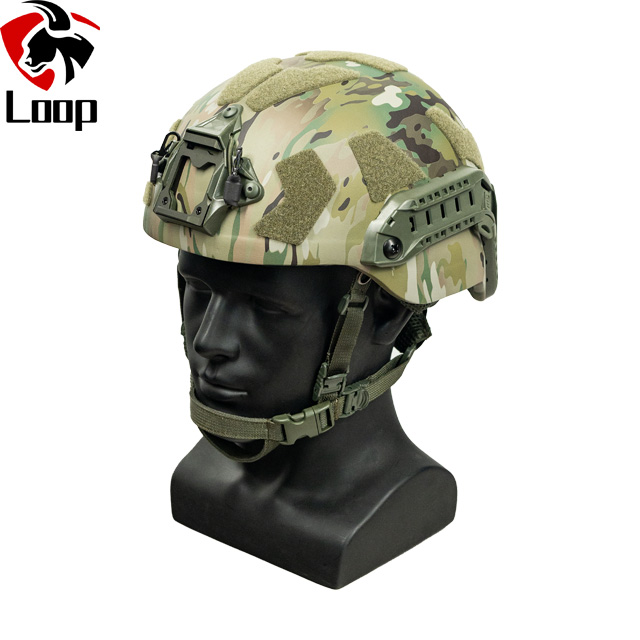
Advanced polymers rely on unique molecular structures. UHMWPE consists of extremely long polymer chains. These extended chains transfer load highly effectively across the material. When a projectile strikes, the kinetic energy travels rapidly along these chains. This rapid dispersion prevents localized penetration. The molecular alignment creates an exceptional strength-to-weight ratio. It vastly outperforms predecessor materials in mass efficiency. A modern UHMWPE helmet leverages this chemistry to maximize threat defeat while minimizing bulk.
To understand the material, look at the manufacturing of the fiber itself. Gel-spinning processes align the polyethylene molecules in a highly parallel structure. This alignment gives the fiber its immense tensile strength. When woven or laid into unidirectional sheets, these fibers act like a microscopic net.
Upon impact, the fibers stretch rather than snap immediately. They pull against the surrounding resin matrix, distributing the force over a wide surface area. This mechanism is entirely different from how older materials handle kinetic energy. The long chains ensure that the energy dissipates before it can punch a hole through the shell.
Comparing these two dominant materials requires objective data. Traditional Aromatic Polyamide (Aramid) relies on woven fibers and heavy resin matrices. Aramid offers excellent heat resistance but carries a significant weight penalty. UHMWPE utilizes unidirectional fiber layers. These layers cross at 90-degree angles. This specific orientation maximizes tensile strength. It yields a specific 15–20% mass efficiency advantage over aramid. UHMWPE absorbs kinetic energy through localized deformation and fiber stretching. Aramid relies more on fiber breaking and resin cracking. The weight savings of polyethylene directly improve user endurance.
When reviewing material durability, you see distinct differences in how the materials age. Aramid fibers degrade when exposed to UV light and moisture. They require thick protective coatings to maintain their ballistic integrity over time. Polyethylene is naturally hydrophobic. It does not absorb water.
Performance Metric | UHMWPE (Polyethylene) | Aramid (Traditional) |
|---|---|---|
Weight Efficiency | 15-20% lighter for equivalent threat levels | Heavier base weight required for IIIA |
Energy Absorption | Excellent dispersion via long polymer chains | Good dispersion via woven fiber friction |
Moisture Resistance | Naturally hydrophobic (water-resistant) | Can absorb moisture if unsealed |
Thermal Limits | Lower melting point (requires outer coating) | High heat and flame resistance |
Manufacturing Process | High-pressure thermal pressing | Resin infusion and molding |
The choice between the two often comes down to the specific operational environment. However, for general tactical use where weight is the primary concern, polyethylene wins.
Processing polyethylene requires highly specialized industrial equipment. A modern ballistic helmet factory utilizes massive hydraulic presses. Technicians layer unidirectional sheets in precise cross-ply orientations. The presses apply extreme pressure and specific heat cycles. This thermal pressing consolidates the layers into a rigid, ultra-light panel. Traditional aramid processing involves molding woven fabrics infused with thermoset resins. The polyethylene method demands tighter temperature controls. Improper heating can degrade the polymer chains. Quality control during pressing dictates the final structural integrity of the shell.
The pressing cycle for UHMWPE is a carefully guarded process. The temperature must reach the exact point where the binding resin flows, but stay below the melting point of the polyethylene fibers. The pressure must be immense—often exceeding 3000 PSI—to eliminate any microscopic air voids between the layers.
If a factory rushes the cooling cycle, the shell can warp. If they apply uneven pressure, the helmet will have weak spots. This is why you cannot buy cheap, unverified helmets. The manufacturing tolerances required for polyethylene are significantly tighter than those for aramid.
Threat defeat verification relies on strict independent testing. A reliable UHMWPE ballistic helmet must stop specific handgun rounds. Testing protocols utilize .44 Magnum and 9mm projectiles. The polyethylene layers capture the bullet upon impact. They deform and disperse the kinetic energy outward. The material's excellent energy absorption profile prevents penetration. Fragmentation testing uses high-speed steel cylinders. The shell must halt these fragments at specific velocities. Verifiable NIJ IIIA protection ensures the gear performs under lethal conditions.
The testing process is brutal. Labs mount the helmet on a magnesium headform. They fire a .44 Magnum Semi-Jacketed Hollow Point at 1430 feet per second directly into the shell. The helmet must stop the round. But stopping the round is only part of the test.
Labs also conduct V50 testing for fragmentation. They shoot 17-grain Fragment Simulating Projectiles (FSPs) at the helmet at increasing speeds. The V50 number represents the velocity where exactly 50% of the fragments penetrate and 50% are stopped. A high-quality polyethylene shell will often achieve V50 ratings exceeding 2200 feet per second.
Stopping the bullet is only the first requirement. Managing the resulting blunt trauma is equally necessary. Backface Signature (BFS) refers to the inward deformation of the shell. Polyethylene can exhibit different BFS characteristics than rigid aramid. It sometimes shows a deeper, localized transient deformation. A reputable helmet manufacturer mitigates this through advanced internal systems. They utilize specialized impact pads and suspension bands. These internal components create a standoff distance. They absorb the blunt force before it transfers to the skull. Proper pad configuration is non-negotiable for safety.
When a bullet strikes a polyethylene shell, the back of the helmet bulges inward. This bulge happens in milliseconds. If that bulge hits the skull, it causes severe blunt force trauma.
To prevent this, modern helmets use dual-density foam pads. The base layer consists of rigid Expanded Polypropylene (EPP). This rigid foam crushes upon impact, absorbing the energy of the backface deformation. The top layer consists of soft comfort foam. You must inspect these pads regularly. If the EPP foam is cracked or compressed from daily use, it will not protect you during a ballistic impact.
Field gear faces harsh environmental extremes. Polyethylene offers exceptional resistance to moisture. It is naturally hydrophobic and resists chemical degradation. Saltwater, sweat, and common solvents do not weaken the fibers. However, the material has thermal limitations. It possesses a lower melting point compared to aramid. Extreme heat environments require careful consideration. Manufacturers apply specialized outer shell coatings to mitigate these risks. Polyurea sprays and epoxy paints seal the shell. These coatings protect against UV radiation and minor thermal exposure. They ensure the structural integrity remains intact over years of service.
If you leave a bare polyethylene panel in a hot vehicle trunk in the desert, the material can degrade. The heat softens the binding resins. To prevent this, a modern ballistic protection helmet features a thick, textured polyurea coating.
This coating acts as a thermal insulator and a physical barrier. It prevents solvents like DEET bug spray or gun oil from reaching the fibers. You must maintain this coating. If you gouge the helmet down to the raw white fibers, you need to seal that scratch. Exposed fibers are vulnerable to environmental damage.
Sourcing protective gear demands rigorous supplier vetting. Procurement teams must look beyond marketing claims. Establish strict criteria for any potential military helmet supplier. Demand current ISO 9001 manufacturing certifications. Request verifiable, independent lab testing reports. These reports must come from NIJ-accredited facilities. Pay close attention to V50 testing data. High V50 numbers demonstrate superior fragmentation resistance. Strict quality assurance protocols ensure batch-to-batch consistency. Never accept self-certified testing data for life-saving equipment.
When you evaluate a supplier, follow a strict vetting process:
Request the full, unredacted ballistic test reports from an independent laboratory.
Verify the laboratory is certified by the National Institute of Justice (NIJ).
Check the date on the test reports. They should be recent, not ten years old.
Ask for the manufacturer's ISO 9001 certificate to verify their quality control processes.
Request a physical sample for destructive testing and internal evaluation.
If a supplier hesitates to provide any of this documentation, walk away. You are buying life support equipment. Transparency is mandatory.
Geometry plays a massive role in modern headgear selection. The high cut helmet design dominates current tactical loadouts. This configuration removes the lower ear coverage. It balances maximum weight reduction with operational necessity. The exposed ear area provides the necessary real estate for headsets. Operators can seamlessly integrate active hearing protection. The raised side profiles also accommodate accessory rails. Polyethylene is particularly suited for this geometry. The material's inherent strength compensates for the reduced surface area. It maintains rigid structural integrity despite the aggressive cut.
The high cut geometry solves the integration problem. Legacy full-cut helmets force operators to wear communication headbands under the shell. This causes severe pressure points and headaches. The high cut allows the headset to mount directly to the ARC rails.
This rail-mounted configuration shifts the weight of the headset off the top of the skull and onto the sides of the helmet. It improves comfort and allows the operator to pop the ear cups open for ambient hearing. The polyethylene shell remains rigid enough to support the tension of these rail-mounted headsets without flexing.
Transitioning an entire department requires strategic planning. Evaluate the long-term operational longevity of the equipment. A modern polyethylene shell offers distinct lifecycle advantages. The primary benefit is injury reduction. Lighter gear directly reduces medical claims for cervical spine injuries. Operators experience fewer lost days due to neck strain. The inherent moisture resistance of polyethylene extends service life. It does not degrade from sweat absorption like older materials. Proper maintenance of the suspension and pad systems maximizes longevity. The initial acquisition yields sustained performance benefits over the deployment cycle.
You must implement a strict inspection schedule to maintain the fleet. The shell itself will last for many years if the outer coating remains intact. However, the internal hardware degrades much faster.
Inspect the chin strap webbing for fraying every six months.
Replace the internal comfort pads annually, as sweat and skin oils break down the foam.
Check the tension on the dial suspension system to ensure the cables are not stretched.
Verify the tightness of the shroud screws to prevent NVG wobble.
By maintaining the hardware, you ensure the polyethylene shell continues to protect the operator effectively.
Request Test and Evaluation (T&E) samples of a lightweight ballistic helmet from vetted manufacturers to conduct physical inspections.
Review independent, NIJ-accredited lab reports focusing specifically on V50 fragmentation data and backface deformation metrics.
Conduct extended operator wear-trials with fully loaded accessory configurations to verify comfort and neck strain reduction.
Inspect the internal suspension and pad systems to ensure they meet modern blunt impact mitigation standards.
A: Modern shells utilize either traditional Aramid or Ultra-High Molecular Weight Polyethylene (UHMWPE). UHMWPE is becoming the standard because its long polymer chains offer an exceptional strength-to-weight ratio. It provides equivalent threat defeat at a significantly lower weight, reducing operator fatigue.
A: When engineered to meet identical threat levels, a polyethylene shell typically delivers a 15% to 20% weight reduction compared to a traditional aramid shell. This mass efficiency allows operators to mount necessary accessories without overloading their cervical spine.
A: Yes. UHMWPE absorbs kinetic energy highly efficiently through rapid load transfer along its continuous polymer chains and localized fiber stretching. This mechanism disperses the impact energy faster and over a wider area than the friction-based breaking mechanisms of woven aramid.
A: Absolutely. When manufactured correctly using high-pressure thermal pressing, polyethylene layers reliably capture and deform .44 Magnum and 9mm projectiles. Independent lab testing verifies that these lightweight shells meet or exceed strict NIJ IIIA penetration and fragmentation standards.
A: Polyethylene has a lower melting point than aramid, making it sensitive to extreme, sustained high temperatures. However, reputable manufacturers apply specialized polyurea coatings and epoxy paints to the outer shell. These coatings effectively insulate the fibers and mitigate environmental and thermal degradation risks.
A: High cut designs remove the lower ear section to accommodate over-the-ear communication headsets and active hearing protection. UHMWPE is ideal for this cut because its high tensile strength maintains the shell's structural rigidity, even with the reduced surface area.


