
Views: 0 Author: Site Editor Publish Time: 2026-06-10 Origin: Site


Short Introduction
In the past, tactical gear focused more on “single-function” and “fixed configurations”; by 2026, more and more users are paying attention to one common direction: modularity.
Whether it is tactical vests, tactical belts, tactical helmets, tactical backpacks, or ballistic plates, medical pouches, communication devices, and accessory systems, modular design is becoming the core trend in industry development.
Its importance does not come only from the fact that “it can be taken apart and reassembled,” but because it truly solves several key problems in modern missions: fast switching between different scenarios, flexible gear combinations, optimized load distribution, convenient later expansion, and improved efficiency in team procurement and management.
This article systematically analyzes why modular tactical gear will become the future trend, what types it has, what it is used for, what differences it has compared with traditional gear, what impacts it will bring, and how to choose it during procurement, helping you better understand the value of modular tactical gear.
Modular tactical gear refers to a tactical system composed of multiple detachable, replaceable, and expandable functional units.
It is not a “fixed” piece of equipment, but rather a gear platform that can be freely combined and adjusted according to mission requirements.
Common modular designs include:
MOLLE system: supports mounting magazine pouches, utility pouches, medical pouches, and other accessories
Quick-release structure: convenient for rapid donning and doffing as well as emergency removal
Detachable plate position: allows users to choose whether to use ballistic plates as needed
Replaceable backpack modules: adjust capacity and compartment layout according to the mission
Combinable belt system: carries equipment and optimizes load distribution
Helmet expansion system: rails, night vision mounts, headset compatibility, etc.
In simple terms, the core logic of modular tactical gear is:
one basic system, adapted to multiple missions.
Modern tactical, security, law enforcement, rescue, and outdoor missions are becoming increasingly diverse.
The same user may be patrolling today, training tomorrow, and providing emergency support the day after.
If the gear has a fixed structure, it is difficult to adapt to all scenarios at once.
The advantage of modular tactical gear is:
adjust the setup quickly according to different missions without repeatedly replacing the entire gear set.
In the past, many buyers focused mainly on whether the gear was durable and whether it could carry items.
Today, users care more about:
Whether it is easy to expand
Whether it is suitable for different missions
Whether it can work together with other gear
Whether it can reduce duplicate procurement
Whether it can be upgraded later
Modular gear perfectly meets these needs, which is why it better fits modern procurement logic.
Modularity is not just “a few more accessories,” but a way to turn gear into a combinable system.
This can bring:
More reasonable gear zoning
More efficient access paths
Better load balancing
Faster mission switching
More convenient team-wide standardization
For professional users, this improvement in efficiency is very important.
Many units or brand customers do not purchase once and stop; instead, they purchase over time, replenish gradually, and upgrade continuously.
One of the biggest advantages of modular gear is strong scalability.
For example:
Purchase a basic tactical vest first
Add a medical pouch module later
Add a communication module later
Upgrade the ballistic plates later
Then pair it with a tactical belt and backpack
This makes procurement more flexible and budget planning more reasonable.
Future tactical gear will no longer follow a single-product logic, but a “system logic.”
Gear must be able to interact:
Vest and belt linkage
Helmet and communication linkage
Backpack and hydration linkage
Plate and vest linkage
Medical pouch and mounting system linkage
Modular design is the foundation for achieving this type of system integration.
This is one of the most core types of modular gear.
Common features include:
MOLLE mounting system
Detachable plate pockets
Quick-release shoulder straps
Adjustable cummerbund
Expandable front and rear accessories
Compatibility with ballistic plates
Camouflage Nylon Combat MOLLE Modular Tactical Vest

Uses:
Carry equipment
Provide a protection platform
Integrate tactical accessories
Support mission switching
Suitable scenarios:
Military and law enforcement patrol
Security operations
Tactical training
High-mobility operations
Tactical belts are evolving from auxiliary gear into core platforms.
Modular belts usually have:
Inner and outer belt structure
Quick-release system
Adjustable stiffness support
Multi-point mounting capability
Compatibility with holsters, magazine pouches, medical pouches, etc.
Special Team Action Removable Adjustable Black Tactical Belt

Uses:
Share the load
Quickly access equipment
Optimize lower-body mounting
Improve operational efficiency
Modular backpacks emphasize compartments, expandability, and compatibility.
They usually support:
MOLLE external mounting
Hydration systems
Medical modules
Utility modules
Supply modules
Replaceable internal compartments
Loop Tactical Backpack Camouflage Outdoors Dragon Egg Bag

Uses:
Mission carrying
Emergency supply support
Item classification
Short- and long-term mission combinations
The modular trend in modern tactical helmets is also very clear.
For example:
Rail systems
Night vision mounts
Communication headset compatibility
Headlamp mounting positions
Hook-and-loop identification areas
Night Vision Mandible Goggles Full-face Ballistic Helmet

Uses:
Device expansion
Mission identification
Communication coordination
Night operation support
Although small in size, these modules are extremely important in real missions and emergency response.
They can be mounted on vests, belts, and backpacks for quick removal.
Uses:
First aid
Supply classification
Rapid response
Mission support
600D Tactical Medical Kit MOLLE EDC Travel

Traditional gear: fixed structure, single function
Modular gear: detachable, replaceable, upgradeable
Traditional gear: suitable for single missions
Modular gear: suitable for multi-mission switching
Traditional gear: limited later upgrades
Modular gear: modules can be added continuously according to mission needs
Traditional gear: one-time purchase
Modular gear: systematic configuration, phased procurement
Traditional gear: simple and direct
Modular gear: more professional, more efficient, and more controllable
Modularity makes gear layout more reasonable, allowing users to find and access needed tools more quickly.
Different missions can be adjusted quickly without replacing the entire system.
Users can purchase modules as needed rather than investing the full budget at once.
Modular gear is easier to standardize, train, and maintain.
For brands and distributors, modular design makes it easier to create differentiated product selling points.
The significance of modularity is not just convenience in assembly and disassembly, but turning gear from a “single tool” into a “tactical system.”
Its tactical significance includes:
Improving gear coordination
Improving mission-switching efficiency
Improving gear utilization
Improving user adaptability
Improving systematic operational capability
For modern tactical, security, law enforcement, and rescue users, this system-oriented thinking is more important than individual gear pieces.
Need to quickly adjust gear setups according to mission changes.
Need to balance carrying, access, protection, and comfort.
Need repeated testing of different module combinations.
Need rapid coordination of medical, communication, and tool modules.
Need flexible adjustments according to environment, weather, and route.
Need a gear system that is standardized, expandable, and capable of continuous replenishment.
Different missions require different levels of modularity.
If it is for patrol and security, comfort and expandability are enough; if it is for high-mobility missions, lightweight design and quick-release systems need to be balanced.
Make sure the gear supports common standards such as:
MOLLE system
Quick-release structure
Common plate sizes
Communication and medical modules
Modularity is not about having more modules, but about whether the modules truly solve real needs.
Blindly adding functions will instead increase weight and complexity.
Good modular gear should have a clear expansion path.
For example:
Basic version → add accessories → upgrade protection → expand communication → add medical modules
Although modular gear is flexible, if the load distribution is not reasonable, it will still affect long-term wearing comfort.
For buyers, brands, and distributors, products that support color, logo, structure, and module customization are more valuable.
Because modular gear depends heavily on design, structure, and workmanship.
The manufacturer’s capability directly affects:
Module compatibility
Stitching quality
Material strength
Quick-release stability
Product lifespan
Bulk delivery capability
OEM/ODM development efficiency
For customers who want to establish long-term cooperation, professional manufacturers are extremely important.
In practical applications, choosing a supplier that can provide professional sizing guidance and customization services is equally important to ensure that tactical gear performs as intended.
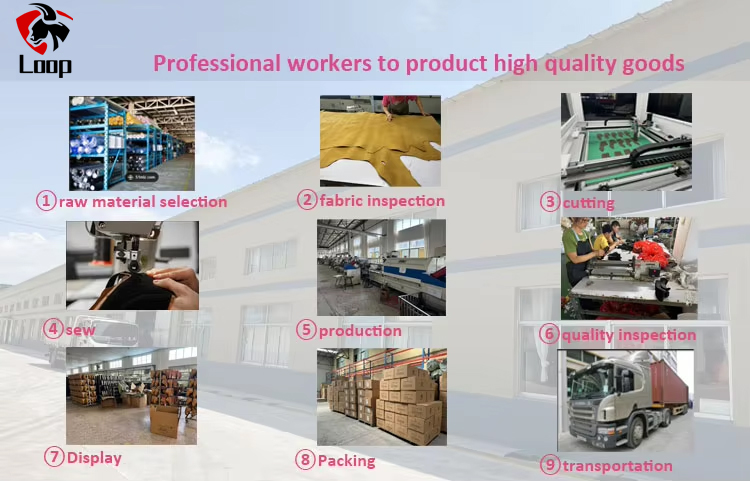
Compared to suppliers that only offer standardized products, we focus on real-world usage scenarios and mission requirements, providing precise sizing recommendations and system-based configuration solutions to achieve an optimal balance between protection, stability, and comfort.
By partnering with Loop, clients benefit from fast pre-production samples and customized based on samples, a stable and efficient rapid delivery system, competitive pricing advantages, and timely access to trending industry product insights—enhancing overall procurement efficiency and market competitiveness.
At the same time, through multi-dimensional customization and support for bulk procurement, we help clients reduce trial-and-error costs, minimize procurement risks, and ensure efficient compatibility among different types of equipment.
Ultimately, what clients receive is not just individual products, but a complete equipment solution that truly fits operational needs and enhances overall mission performance.
Click here to contact us for Tactical Gear customized services.
Because the future direction of gear development is already very clear:
lighter, faster, more flexible, more expandable, and more systematic.
Modularity fits these trends perfectly.
It allows users to:
Combine gear according to missions
Adjust configurations according to environments
Make phased purchases according to budgets
Standardize team management according to systems
Continuously upgrade according to needs
This is the core reason why modular tactical gear will become the future trend.
Modular tactical equipment has become a future trend not simply because it is more advanced, but because it effectively addresses modern users’ needs for flexibility, compatibility, scalability, and cost efficiency.
From tactical vests and tactical belts to tactical backpacks and ballistic helmets, modular design is reshaping the entire tactical equipment industry. For end users, it means higher mission efficiency and a better user experience. For brands, distributors, and procurement professionals, it means stronger market competitiveness and greater product value.
As tactical gear continues to evolve toward lighter weight, smarter functionality, and more integrated systems, modular tactical equipment will undoubtedly remain one of the most important development trends in the global tactical gear market.
If you are looking for high-quality ballistic vest, ballistic helmet, ballistic plate, Bulletproof Shield, Combat Uniforms, or other tactical accessories, contact us today. We provide professional-grade solutions, competitive pricing, and fast delivery to build a reliable tactical system for your needs.
Click here to contact us for Tactical Gear customized services


